
Why Financial Signals and the Real Economy Diverge Persistently
Equity markets near record highs while industrial production stagnates: this configuration recurs whenever the financial sphere operates with relative autonomy from physical production flows. The Eco3min framework shows that this dissociation is structural rather than anomalous, rooted in the gap between balance-sheet inertia and the real-time pricing of expectations.

TL;DR
Asset prices direct capital allocation under balance-sheet and liquidity constraints, on a compressed time horizon that the productive economy, bound by installed capacity and accumulated debt, cannot match.
- An equity quote, bond yield or credit spread aggregates expectations, positioning constraints and portfolio arbitrage; its function is to allocate capital under uncertainty, not to certify factory activity or order-book health.
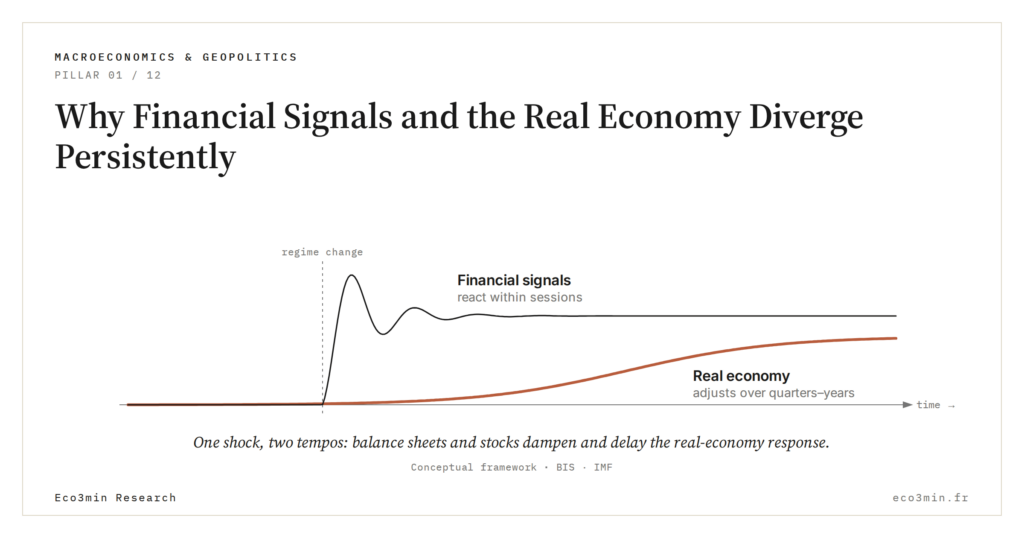
- Real-economy variables such as installed capital, accumulated debt, skills and infrastructure evolve with inertia, and BIS research finds macro adjustments transit through balance sheets and financial conditions first, with lags running into several quarters or years for long credit cycles.
- Widely cited gauges like the CAC 40, the VIX and sovereign spreads work as coordination tools among market participants rather than universal thermometers, so their stability can mask unfinished structural adjustments.
Equity markets flirt with all-time highs while European industry struggles to recover. Credit spreads compress even as corporate defaults rise. These apparent contradictions regularly fuel commentary on a finance “disconnected from the real economy”. Yet this reading rests on a rarely questioned premise: that market prices should provide an instant snapshot of the productive economy. This expectation is fundamentally inadequate to the very nature of financial markets.
Rather than tracking a hypothetical failure in price formation, the conceptual framework used to interpret these signals deserves scrutiny. The relevant question is not why markets and the real economy diverge, but why they would have to converge. This shift in perspective radically changes the analysis.
The Eco3min framework systematically distinguishes between price signals, structural constraints, and real-economy dynamics, in order to avoid any instantaneous or causalist reading of the economy.
This reading aligns with research developed by the Bank for International Settlements (BIS), the IMF, and central banks, which analyse the dissociation between financial signals and the real economy through balance-sheet dynamics, stocks, and transmission mechanisms.
The deeper nature of a market signal
An equity quotation, a bond yield or a credit spread never constitutes a snapshot of the economic situation. These metrics aggregate expectations, positioning constraints and portfolio arbitrages that obey their own logic. Their primary function is to direct capital allocation in an environment of radical uncertainty, not to certify factory activity levels or the health of order books.
Markets operate in a conceptual space where time is compressed by the discounting of future cash flows, where balance sheets matter more than income statements, and where liquidity is as decisive a variable as fundamentals. In this universe, nothing prevents valuations from rising even as industrial production stagnates. There is no aberration here, simply two distinct registers of analysis.
Confusing a price signal with an economic diagnosis amounts to assigning markets a mission they never had. This misunderstanding is reinforced by the media omnipresence of a handful of indicators (the CAC 40, the VIX, sovereign spreads) presented as universal thermometers when they primarily function as coordination tools among market participants.
A structural decoupling, not a cyclical one
The simultaneous observation of euphoric markets and a sluggish economy is no historical exception. It is a recurring configuration whenever the financial sphere has its own drivers and a relative autonomy from the physical flows of production and consumption.
Market participants integrate multiple time horizons, arbitrage between heterogeneous asset classes, and respond to regulatory or liability constraints specific to them. The productive economy, by contrast, remains tied to installed capacity, contractual commitments and institutional rigidities whose transformation unfolds over years. This tempo gap is not an accident but a constitutive property of the system.
Denouncing markets for “denying reality” generally betrays an overly mechanical view of the links between finance and production. Asset prices neither validate nor invalidate the present state of the economy: they map the field of possibilities for future investment and financing decisions.
This divergence also reflects the inherent logic of the business cycle. Financial markets operate ahead of real-economy inflections, while the productive economy reacts with a lag, weighed down by stock inertia, balance-sheet effects and past investment commitments. Reading their trajectories as if they should converge continuously ignores the fundamentally asynchronous nature of the cycle’s phases.
The balance-sheet economy versus the flow economy
To grasp this dissociation, the focus must shift from current flows (GDP, output, consumption) toward accumulated stocks. The real economy remains constrained by inherited structures: the installed capital base, accumulated debt, available skills, infrastructure networks. These balance-sheet variables evolve with considerable inertia. Markets, by contrast, react to marginal shifts in perceived conditions, sometimes within a few sessions.
According to BIS research on financial cycles, macroeconomic adjustments first transit through balance sheets and financial conditions before translating into investment and employment: a structural dynamic examined in our analysis of the real business cycle, with lags that can stretch over several quarters, or even several years in the case of long credit cycles.
This temporal asymmetry explains why prices can adjust abruptly to a change in monetary or fiscal regime, while the productive apparatus remains locked into trajectories from which it cannot extract itself rapidly. Balance sheets (whether of firms, households or states) act as stabilisers that constrain any rapid reconfiguration.
Expecting markets to faithfully reflect this stock-based economy leads to overestimating their descriptive power and underestimating the weight of real structures.

The trap of seemingly robust indicators
Several commonly cited macroeconomic statistics contribute to maintaining the confusion. Their relative stability is often brandished as proof of economic resilience, when it frequently reflects unfinished adjustments, composition effects or rigidities that mask underlying tensions.
Mobilising these figures to demonstrate coherence between the financial sphere and the productive economy follows from a synchronic reading that ignores the lags inherent in the system. This approach becomes particularly misleading when markets have already priced in a new constraint regime that the real economy has not yet absorbed.
It is precisely in such configurations that using a framework for identifying misleading economic indicators helps to distinguish apparent stability from structural soundness, without resorting to a cyclical interpretation.
Equating the stability of macroeconomic or financial indicators with a validation of real-economy strength, without integrating stock and balance-sheet constraints.
Constraints rather than a dashboard
The persistence of seemingly contradictory signals reveals above all a category error. Neither equity quotations nor monetary policy decisions function as direct controls of economic activity. They define an environment of constraints, costs and incentives within which firms and households make their decisions.
This architecture implies that the adjustments observed in the real economy do not respond to immediate causality. They result from the complex interaction between pre-existing structures and modifications of the financial environment. The dissociation between the two spheres then becomes not only intelligible but predictable.
Understanding how these constraints concretely translate into the real economy requires analysing the specific transmission mechanisms, addressed in our dedicated analysis.
Financial signals organise capital allocation under constraints that operate independently of the immediate state of the real economy, which makes their dissociation not only possible but structural.
- Financial markets do not measure real activity; they organise capital allocation under constraints.
- The finance–real economy dissociation results from balance-sheet inertia and stock-based structures.
- Reassuring indicators can mask persistent structural fragilities.
For a structuring and timeless macroeconomic framework on these dynamics, see also the pillar page Macroeconomics & geopolitics.
Last updated — 7 October 2026
Disclaimer – Financial and Legal Information: The analyses, commentary, and content published on eco3min.fr are provided for informational and educational purposes only. They do not constitute investment advice or a solicitation to buy or sell financial instruments. Past performance is not indicative of future results. All investment decisions involve risk and are the sole responsibility of the reader. Data, charts and calculated series are provided as is and may contain errors or lag behind their source: check any figure against the primary source cited before relying on it. Content describing laws, regulations or contracts reflects the law as of its publication date and does not constitute legal or tax advice; applying it to a specific situation requires a qualified legal or tax professional.
Read next
Full pillar →US–China Semiconductor War: The Real 2026 Battlefield
Late-2025 US restrictions still target ≈40% of China's advanced AI compute capacity, while Beijing tightens critical-mineral exports. The…
Hidden Unemployment: What Labor Slack Says Beyond the Jobless Rate
The gap between US broad and official unemployment, 3.4 points in September 2026, is practically where it stood…
Positive Real Rates: How the Cost of Money Is Reshaping the Economy
The US 10-year real yield went from −1.19% in 2021 to 2.91% in October 2026 while expected inflation…