
Gold Priced in Dollars, Portfolio in Euros: What FX Adds to the Position

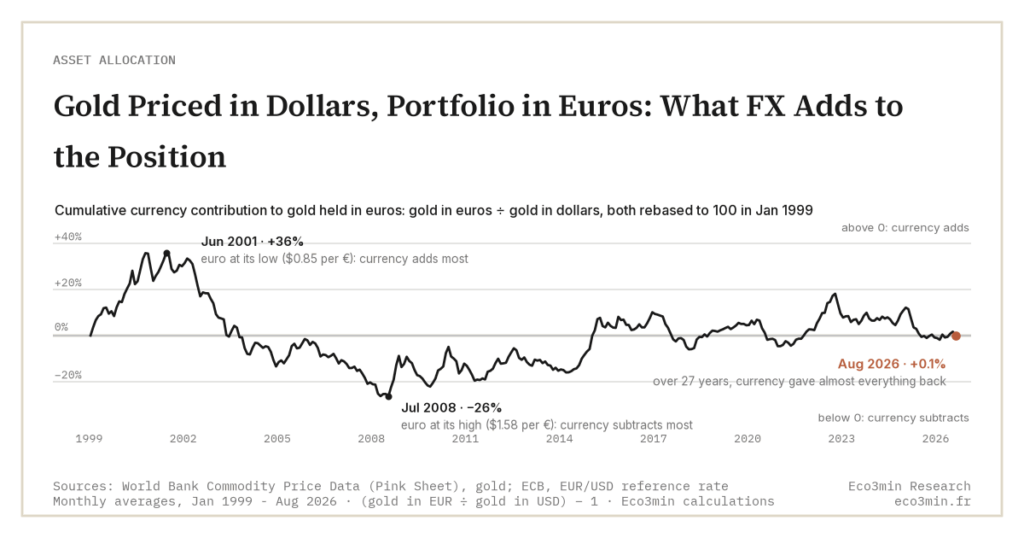
Gold is priced in dollars but most often held in euros: for a European holder, the return combines the metal’s move in dollars and the euro’s move against the dollar. Currency is a second layer, neither neutral nor always visible.
TL;DR
Holding gold in euros embeds an implicit euro-dollar position alongside the metal, so the same dollar gold price can set records in one currency while doing nothing in the other.
- Gold up 5% in dollars with the dollar gaining 3% against the euro returns about 8% to a euro holder, but only about 2% if the dollar instead weakens 3%.
- Because gold and the dollar move inversely, the currency layer usually offsets part of the move, yet that cushioning is a tendency rather than a rule and reverses into amplification when gold and the dollar rise together, as in 2024 (+30.7% in dollars, +36.0% in euros).
- Euro-hedging cancels the parity effect at roughly the US to euro-area rate gap per year, while leaving the position unhedged keeps an implicit dollar exposure that can cut both ways.
This piece isolates what currency adds to a gold position for a euro-based investor: an exchange-rate exposure layered onto the metal exposure, one the dollar quote hides.
Gold is quoted in dollars, but most European holders own it in euros. Between the two sits the exchange rate, and it is not neutral. Gold and the dollar share a historically inverse relationship: when the greenback weakens, dollar-denominated gold tends to rise, and vice versa. For a euro-based investor, that link is layered onto a second move — the euro against the dollar. The upshot: the same dollar gold price can produce very different returns depending on the reference currency. In some stretches, gold set records in euros without doing so in dollars, and the reverse. This piece does not rehearse the arbitrage mechanics in detail; it draws the consequence for a holding.
Two layers in one position
For a euro-based holder, the return on a gold position breaks into two terms. The first is the metal’s move in dollars; the second, the change in the euro against the dollar between purchase and measurement. Roughly, the euro return is the sum of the two: if gold rises 5% in dollars and the dollar appreciates 3% against the euro, the European holder gains about 8%; if the dollar weakens 3% over the same span, the gain falls to around 2%. The dollar price therefore tells only half the story — the other half is a dollar exposure the position embeds by construction, as the analysis gold and the dollar in the position sets out.
That second layer is easy to overlook because it is silent. An investor tracking the ounce in dollars believes they are tracking their own performance; in fact they are watching only one of the two terms. As long as the euro and the dollar stay stable against each other, the confusion is harmless. The moment the parity moves — and it does — the gap between the quoted price and the return actually received can become substantial on a position held over months or years.
The relative weight of the two layers depends on the horizon. Over a few days or weeks, currency swings can dominate the price noise, to the point where a euro holder sees their position move while gold, in dollars, has barely budged. Over several years, the reverse holds: the metal’s move eventually outweighs the parity oscillations. But even over the long run, currency does not net out: the level of euro-dollar at the moment of measurement shifts the cumulative result, sometimes by tens of percent relative to the dollar read. Measured from January 1999 on monthly averages, the currency contribution peaked at +36% in June 2001 (euro at $0.85), fell to −26% in July 2008 ($1.58) and stood at +0.1% in August 2026.
When currency amplifies, when it cancels
The two layers are not independent, and that is where the reading gets interesting for a euro holder. Because gold and the dollar move inversely, their effects tend to partly offset in a position held in euros. When the dollar weakens, gold in dollars rises (a gain on the first layer) but the euro conversion is unfavourable (a loss on the second): part of the move cancels out. That offset is why gold in euros is often less volatile, in its currency dimension, than a naive read would suggest. The fine mechanics of this international arbitrage belong to the gold–dollar arbitrage mechanic, treated separately; here we keep only the consequence for the holding.
That offset, however, is neither complete nor stable. The inverse relationship between gold and the dollar is a tendency, not a law: in some phases the two rise or fall together, and the currency layer stops cushioning and starts amplifying. That happens when gold rises in dollars while the dollar appreciates: in 2024 (December-to-December monthly averages), gold gained 30.7% in dollars and the dollar 4.0% against the euro, or 36.0% for a euro holder (World Bank Pink Sheet; ECB reference rate). Conversely, in 2025 a 62.7% rise in dollars shrank to 45.6% in euros as the dollar lost 10.5%. Strong-dollar years with flat or falling gold, such as 2015 (−10.4% in dollars, +1.6% in euros), are cushioning, not amplification. That kind of configuration, beyond this article’s scope, is analysed as a strong-dollar regime in its own right. To track the greenback against a basket of currencies, one can refer to the broad dollar index published by the Federal Reserve.
The practical consequence is that a euro holder never owns “gold” in the pure sense: they own a basket of gold and an implicit euro-dollar position. Depending on the regime, that implicit position reduces or worsens the volatility of the whole. Records in euros without records in dollars, or the reverse: these gaps, often wrongly attributed to the metal alone, are merely the footprint of the currency layer.
Recent episodes illustrate this. In phases where the euro weakened markedly against the dollar, gold in euros set highs its dollar price had not yet reached, the currency adding to the metal’s move. Conversely, in strong-euro periods, a European holder could see their position stagnate in euros even as the ounce advanced in dollars. These gaps say nothing about the metal’s intrinsic value; they measure the contribution, positive or negative, of the currency.
Hedging the currency, or carrying it
From this dual exposure follows a decision: keep the currency layer, or neutralise it. A euro holder who wants a “pure” exposure to the metal can use euro-hedged vehicles, which cancel the euro-dollar effect; what remains is only the gold move in dollars, converted at a constant rate. Conversely, keeping an unhedged exposure means accepting — even seeking — the implicit dollar position. Neither option is superior in the absolute: hedging the currency has a cost and removes a possible source of diversification, while not hedging adds a volatility that can cut both ways. Also relevant: gold seen through the real-rate lens.
The detail of these vehicles — hedged or not, their fees, their behaviour — belongs to the choice of instrument, and that is precisely the subject of the satellite examining hedging the currency or not at the vehicle level. What matters here comes earlier: understanding that the currency decision exists, that it is distinct from the choice of metal, and that it reshapes the position’s profile. This logic rejoins the sub-pillar’s thesis, where positioning a portfolio for the regime means consciously choosing each layer of exposure, currency included.
One technical point deserves a mention without going into detail: hedging the currency is not free, and its cost is not arbitrary. It roughly reflects the interest-rate gap between the two currencies. When US rates exceed euro-area rates, hedging a dollar exposure costs about that differential a year, which reduces the return on a hedged position accordingly. This cost does not invalidate hedging, but it is a reminder that it is paid for — and that a “pure exposure to the metal” has a concrete price. Directly related: our mapping of vehicles by macro phase.
Three consequences of currency for a euro holder
Three observations, without extrapolation. First, the return on a gold position for a euro-based holder breaks into two terms — gold in dollars and euro-dollar — of which the quoted price shows only the first. Second, because gold and the dollar move inversely, the currency layer tends to cushion the move, though that offset is neither assured nor stable. Third, hedging the currency or not is a decision distinct from the choice of metal, and it reshapes the risk profile of the whole.
- For a euro holder, the return on a gold position combines the gold move in dollars and the euro’s move against the dollar; the dollar price shows only half of it.
- Because gold and the dollar move inversely, the currency layer tends to offset part of the move — but that offset is a tendency, not a rule.
- When gold and the dollar rise together, as in 2024, both effects pull the same way and amplify rather than cushion.
- Hedging the currency or carrying it is a decision of its own, distinct from the choice of metal and vehicle.
Frequently asked questions
Why does the gold price in euros differ from the price in dollars?
Because gold is quoted in dollars and its value in euros also depends on the euro-dollar exchange rate. When the euro weakens against the dollar, gold in euros rises more than in dollars, and vice versa. The same dollar price can therefore produce different returns depending on the reference currency.
Does the gold-dollar relationship protect a euro-based investor?
It tends to cushion the move rather than protect. Because gold and the dollar move inversely, their effects partly offset for a euro holder, which often lowers currency volatility. But that offset is neither complete nor stable: in some regimes, the two effects add up.
What does hedging the currency on a gold position involve?
Hedging the currency neutralises the euro-dollar effect and leaves exposure to the gold move in dollars alone. It carries a cost and removes a possible source of diversification. Not hedging keeps the implicit dollar position, which adds a volatility that can cut both ways.
Over the long run, does the currency effect net out?
Not in any regular way. Over several years, the metal’s move tends to dominate, but the euro-dollar level at both measurement dates shifts the cumulative result. Since January 1999, the currency contribution to gold held in euros has swung from +36% (June 2001) to −26% (July 2008) before returning to +0.1% in August 2026: it depends on the dates chosen, not on the holding period.
Last updated — 6 October 2026
Disclaimer – Financial and Legal Information: The analyses, commentary, and content published on eco3min.fr are provided for informational and educational purposes only. They do not constitute investment advice or a solicitation to buy or sell financial instruments. Past performance is not indicative of future results. All investment decisions involve risk and are the sole responsibility of the reader. Data, charts and calculated series are provided as is and may contain errors or lag behind their source: check any figure against the primary source cited before relying on it. Content describing laws, regulations or contracts reflects the law as of its publication date and does not constitute legal or tax advice; applying it to a specific situation requires a qualified legal or tax professional.
Read next
Full pillar →Gold’s Role Across the Real-Rate Regime
Over half a century, the real gold price has shown no relationship with inflation (correlation +0.04) but has…
Target-Date Funds vs Self-Directed Portfolios: The Mechanics of a Delegated Glide Path
A target-date fund is sold as a simple, set-and-forget win. It is first something narrower: a delegated glide…
What Guaranteed Savings Products Have Paid: Fixed Annuity and Stable Value Yields Through the Rate Cycle
US guaranteed savings products credit a rate that trails the bond market rather than tracking it. Through the…