
What Is a Commodity and Why Its Price Fluctuates
Commodities are physical inputs constrained by geological, agricultural and energy realities. Their prices reflect imperfect adjustments between rigid supply, financial demand and expectations, with structural lags that explain persistent volatility.

TL;DR
Commodity prices stay structurally unstable because physical supply cannot adjust to shocks in time: new capacity takes years, so imbalances transit through price rather than volume.
- Lead times to bring new mines, oil fields or farmland online run from three to ten years, leaving short-term supply quasi-inelastic.
- Physical volumes shift slowly while financial positions reallocate within days, a temporal gap that can detach price moves from any real material imbalance.
- Energy, metals and agriculture each follow distinct dynamics; reading commodities as one homogeneous bloc obscures these differences.
- A sustained rise in energy or industrial input prices diffuses through the whole production system even without strong growth, which makes commodities a leading indicator of economic tensions.
A physical good, not an abstract asset
A commodity does not exist in conceptual or contractual form: it must be extracted, produced, stored and transported. This materiality imposes constraints that neither financial assets nor most manufactured goods face. A barrel of oil, a tonne of copper or a bushel of wheat cannot be substituted in the short term by mere economic decision. This absence of immediate flexibility profoundly distinguishes commodities from other asset classes. Where a corporation can adjust its volumes, prices or product range, the production of natural resources depends on incompressible lead times, often measured in years. On this, see the altitude constraint on growing arabica. This physical foundation is what makes commodity prices structurally unstable.Why supply never adjusts in time
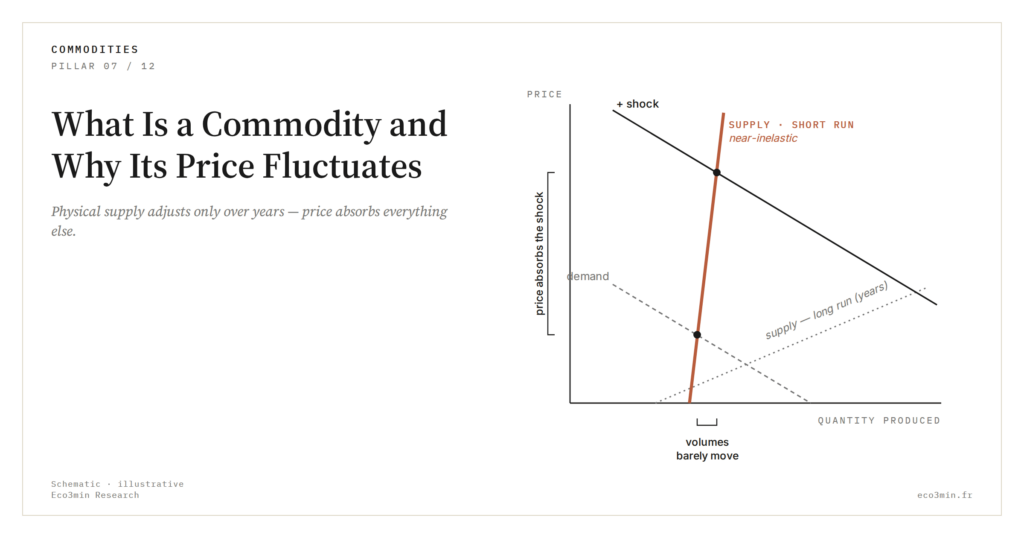
Commodity price formation rests largely on rigid supply. Opening a mine, developing an oil field or transforming an agricultural system requires heavy investment, long visibility and multiple authorisations. Between the investment decision and the actual arrival of new capacity, observed lead times generally range from three to ten years depending on the segment. In the short term, supply is therefore quasi-inelastic. A price increase does not immediately trigger an increase in available volumes. Conversely, a price decline does not produce an instant production cut, because fixed costs remain high. This inertia explains why adjustments first transit through prices, not through quantities. Prices absorbing what volumes cannot is the mechanism at the centre of commodity price formation under physical constraints.Demand, expectations and temporal dissociation
On the demand side, commodities are consumed by both the real economy and financial actors. Industrial users adjust their purchases based on production needs, while financial actors react to macroeconomic expectations, monetary conditions and portfolio arbitrage. Related material: Chinese steel demand through iron ore. This coexistence creates a central temporal dissociation: physical volumes evolve slowly, while financial positions can be reallocated in a matter of days. This logic is developed in greater detail in the reference analysis devoted to the contrast between physical supply and financial demand in price formation, which shows why price moves do not always translate into an immediate material imbalance. This gap between fast financial dynamics and slow physical adjustments can however only be fully understood when placed within the logic of real commodity cycles, where material constraints, investment lead times and macroeconomic transmission shape price trajectories well beyond cyclical shocks. This logic of incompressible lead times and delayed adjustments also explains why commodities evolve along long, recurring cycles. Phases of underinvestment, followed by prolonged tensions and then overcapacity, structure price moves that go well beyond cyclical fluctuations. This dynamic is detailed in the analysis devoted to the cyclical nature of commodities, which shows why these markets mechanically alternate between apparent shortage and excess supply.What makes the fluctuations structural
Commodity prices are intrinsically unstable because they must absorb multiple shocks with limited room for adjustment. A weather event, a geopolitical decision or a shift in financial conditions feeds directly into prices, since it cannot diffuse rapidly through volumes. Mainstream projections often assume that market mechanisms eventually restore equilibrium. This reading rests on the assumption of a relatively quick supply-side response. In practice, however, the cumulative lags of investment, regulation and logistics frequently extend periods of tension, even when demand slows. This connects to the price gap as a supply-stress indicator.Why this question is becoming more visible now
Since 2024–2025, the persistence of positive real interest rates has reshaped the cost of capital for extractive and agricultural projects. This financial constraint slows supply expansion at a time when some value chains remain under stress. The gap between price signals and physical capacity is therefore showing more clearly than during the previous decade.What readers are really trying to understand
The real question is not whether commodity prices will rise or fall in the short term, but whether they reflect a durable constraint or a transitory adjustment. Behind this question lies above all the concern of misreading a price signal, confusing financial volatility with a real physical imbalance.Common reading errors
The first error consists in equating any price increase with an immediate shortage. In many cases, the move primarily reflects expectations or financial arbitrage. A second frequent confusion is to assume that low prices guarantee a swift return to equilibrium. If supply remains constrained by structural factors, the easing can be temporary. Lastly, analysing commodities as a homogeneous bloc obscures the fundamental differences between energy, metals and agriculture, each of which follows its own dynamic.Key variables to monitor
- Average lead times to bring new capacity online
- Commercial and strategic inventory levels
- Cost of capital and project financing conditions
- Gaps between marginal costs and market prices
Macro reading and economic implications
Commodity price fluctuations have direct effects on inflation, corporate margins and macroeconomic stability. A sustained rise in energy or industrial input prices gradually diffuses through the entire production system, even in the absence of strong growth. This mechanism explains why commodities act as a leading indicator of economic tensions, complementing statistics published with a lag. This reading fits within the broader framework developed on the pillar page Commodities and the global economy.What could invalidate this reading
An unexpected acceleration in productive investment, a marked negative demand shock or a major regulatory shift could reduce the observed volatility. Conversely, a durable tightening of financial conditions would prolong current imbalances.What this dynamic concretely implies
- Prices should not be read as instant equilibrium signals
- Commodity cycles run longer than financial cycles
- Volatility is a structural feature, not an anomaly
Last updated — 21 July 2026
Disclaimer – Financial and Legal Information: The analyses, commentary, and content published on eco3min.fr are provided for informational and educational purposes only. They do not constitute investment advice or a solicitation to buy or sell financial instruments. Past performance is not indicative of future results. All investment decisions involve risk and are the sole responsibility of the reader. Data, charts and calculated series are provided as is and may contain errors or lag behind their source: check any figure against the primary source cited before relying on it. Content describing laws, regulations or contracts reflects the law as of its publication date and does not constitute legal or tax advice; applying it to a specific situation requires a qualified legal or tax professional.
Read next
Full pillar →Commodity Price Formation: Time Asymmetry and Structural Mechanisms
Commodity prices do not register an instantaneous supply–demand equilibrium. They register a structural asymmetry: physical supply takes years…
Reading the refinery utilisation rate: the threshold, the season, the turnarounds
A refinery runs full near ninety percent, not a hundred: the last slice of nameplate capacity is a…
The 2022–2023 refining golden age: anatomy of an episode
In 2022, refined fuel prices climbed faster than crude. That gap, measured by the 3-2-1 crack spread, reached…