
Financial Education: The Blind Spots on Real Risk
Financial education trains practitioners to manage volatility, asset allocation, and time horizons. Yet structural risk migrates within market regimes and financing channels that conventional curricula leave unexamined.

TL;DR
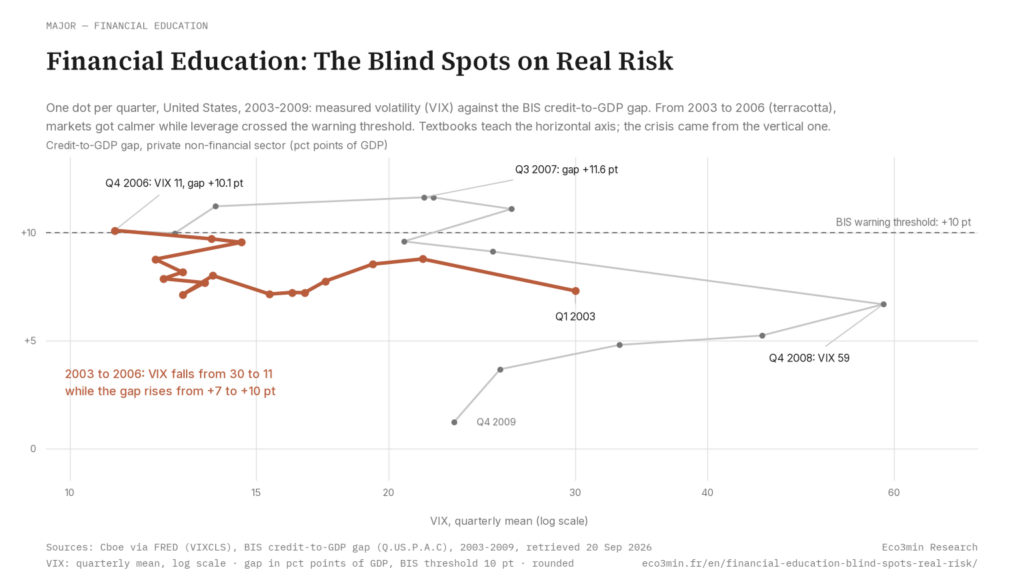
Standard financial education builds real competence around quantifiable risk like volatility and drawdowns, while the risks that actually matter form elsewhere: in Q4 2006 the VIX averaged 11.0, the third calmest quarter since 1990, just as the US credit-to-GDP gap crossed the BIS warning threshold of 10 points for the first time.
- A core blind spot is conflating quiet markets with sound ones. Claudio Borio, at the BIS, named it the paradox of financial instability: the system looks strongest precisely when it is most fragile, because risk premia and volatility bottom out exactly when risk is highest.
- Conventional teaching neglects market microstructure: effective liquidity quality, order concentration, leverage exposure and the weight of marginal participants, the parameters that decided how fast the August 2024 yen carry trade unwind propagated, on a position the BIS sized at about USD 250 billion.
The Paradox of the Well-Trained but Ill-Prepared Investor
Contemporary financial education sets out to transform retail savers into rational investors. This pedagogical agenda is structured in our sub-pillar on financial methods and principles, which lays the conceptual foundations this study extends. It teaches discipline, resilience to emotional biases, the merits of diversification, and the importance of long horizons. On these stated objectives, it generally delivers.
Yet this approach suffers from a rarely examined flaw: it trains practitioners to detect apparent risks, not substantive ones. The canonical concepts (volatility, asset allocation, investment horizon) convey a sense of control while obscuring the deeper dynamics that actually shape risk distribution within the financial system.
This analysis extends the dedicated pillar page on financial education, exploring not the substance of what is taught but its systematic omissions.
What Financial Teaching Leaves in the Shadows
A Conception of Risk Captive to the Quantifiable
Most financial education curricula rely on accessible, retrospective metrics: historical standard deviation, maximum drawdowns, correlation coefficients, diversification indices. These instruments offer undeniable utility, but rest on a tacit premise: past configurations provide a reliable guide for the future. The wider context: the case for 60/40 or all weather.
Yet systemic risk never conforms to statistical expectations. It surfaces precisely when regimes shift, when interdependencies reconfigure, and when funding channels seize up. The BIS holds the longest record on this: the credit-to-GDP gap built by Claudio Borio and Philip Lowe in 2002 became the Basel III reference for the countercyclical capital buffer in 2010, and remains the best univariate predictor of systemic banking crises (Drehmann and Tsatsaronis, BIS Quarterly Review, March 2014).
The Illusion That a Calm Market Equals a Safe Market
Another fundamental bias consists in conflating quietness with soundness. Financial education values perseverance and consistency, but does little to prepare practitioners for the reality that contained volatility can mask growing structural fragility. The United States between 2003 and 2007 is the canonical case, and it can be measured. From 2004 to Q2 2007 the VIX held a quarterly average well below that of the whole 1990-2026 period, bottoming in Q4 2006 as the third calmest quarter in thirty-five years. Over the same stretch the US private non-financial credit-to-GDP gap climbed from 7.3 points in Q1 2003 to 10.1 in Q4 2006, crossing the 10-point BIS warning threshold for the first time, then peaked at 11.6 in Q3 2007. Textbooks taught the first axis; the crisis came from the second.
This misreading is amplified by an overly aggregated reading of markets: composite indices, average returns, dominant narratives. What unravels behind the scenes (market depth, performance heterogeneity, balance-sheet health) remains invisible as long as the statistical façade holds.
This pedagogical blind spot resonates particularly in configurations where information abounds without producing actionable signals. When macroeconomic forces neutralize each other, when aggregates stagnate, and when vulnerabilities migrate beyond the conventional analytical spectrum, risk becomes imperceptible before crystallizing. This is traced in detail in the study dedicated to market phases without exploitable signals, which establishes how the absence of a signal is itself a structural data point.
Understanding Risk as Architecture, Not as Parameter
Eco3min Analytical Extension
If risk is to be understood as a capacity for structural resilience rather than mere observable volatility, the key question becomes: can your financial situation absorb a sustained shock without disorganizing?
That is precisely the purpose of the Eco3min financial resilience simulator, designed to assess not return or performance but the overall robustness of a financial trajectory facing realistic scenarios: persistent inflation, income decline, sustained rate increases, or extended unforeseen events. A complementary angle: Nominal vs Real Economic Data: Why Inflation Changes the Picture.
The tool deliberately emphasizes safety margins, budgetary flexibility, and the invisible vulnerability points that conventional pedagogical frameworks overlook, concretely extending the blind spots analyzed in this article.
Rethinking Risk Beyond Price Oscillations
In a rigorous macro-financial perspective, risk is not reduced to price fluctuations or to the probability of an isolated loss. It refers to the capacity of a structure to absorb a disturbance without altering its operation. Further detail: volatility and risk as two distinct concepts.
An asset can display low volatility while still presenting a high risk profile when it depends on specific refinancing conditions, narrow operating margins, or permanent access to liquidity. Conversely, a high-amplitude asset can prove relatively resilient if it relies on recurring flows and a sound balance-sheet structure.
The Dimensions Standard Metrics Ignore
Conventional pedagogical instruments largely neglect market microstructure: effective liquidity quality, order concentration, leverage exposure, and the weight of marginal participants. Yet these are the parameters that determine how a shock propagates. The BIS documented it on the August 2024 episode: its bulletin of 27 August 2024 describes volatility amplified by procyclical deleveraging and rising margin calls, on a yen carry trade it sized at roughly JPY 40 trillion, or USD 250 billion, entering the month, while noting that outright market dysfunction was averted that time.
When these vulnerabilities accumulate, risk does not grow linearly. It migrates, then manifests abruptly when the market regime shifts.
Late Cycle: A Revealer of Pedagogical Blind Spots
The Decisive Influence of the Cost of Capital
Cyclical maturity phases are characterized by a sustained increase in the cost of capital and by less accommodative real rates. The temporal hierarchy of wealth-related decisions imposed by these transitions is developed in our study on structuring decisions over time. These shifts profoundly transform the risk hierarchy long before valuations register them. How assets absorb those shifts is decomposed in why markets react to rate changes rather than rate levels.
Strategies that appeared robust in a generous-liquidity environment gradually become dependent on increasingly discriminating financing. This gradual mutation almost systematically escapes the analytical frameworks that are taught.
These mechanisms are detailed in the pillar article on real policy rates and their role in pricing risk assets.
Performance Dispersion: An Underestimated Signal
In late cycle, trajectories cease to converge. Some securities or asset classes continue their ascent while others quietly deteriorate. The composite index obscures this dispersion, and financial education, fixated on averages, misses it.
This phenomenon emerges with particular clarity in the analysis of earnings releases and surprises relative to expectations, where apparent market serenity coexists with growing underlying fragility.
What This Framework Adds
What This Approach Allows One to Decode
Identifying the biases of financial education does not confer the power to predict a turn or to anticipate a specific shock. It does, however, open access to an anticipatory reading of the risk regime: where it concentrates, by what logic it migrates, and why it slips off the radar before resurfacing. The prediction toolkit itself has a weak record at such junctures, reviewed in why economic forecasts fail during regime changes.
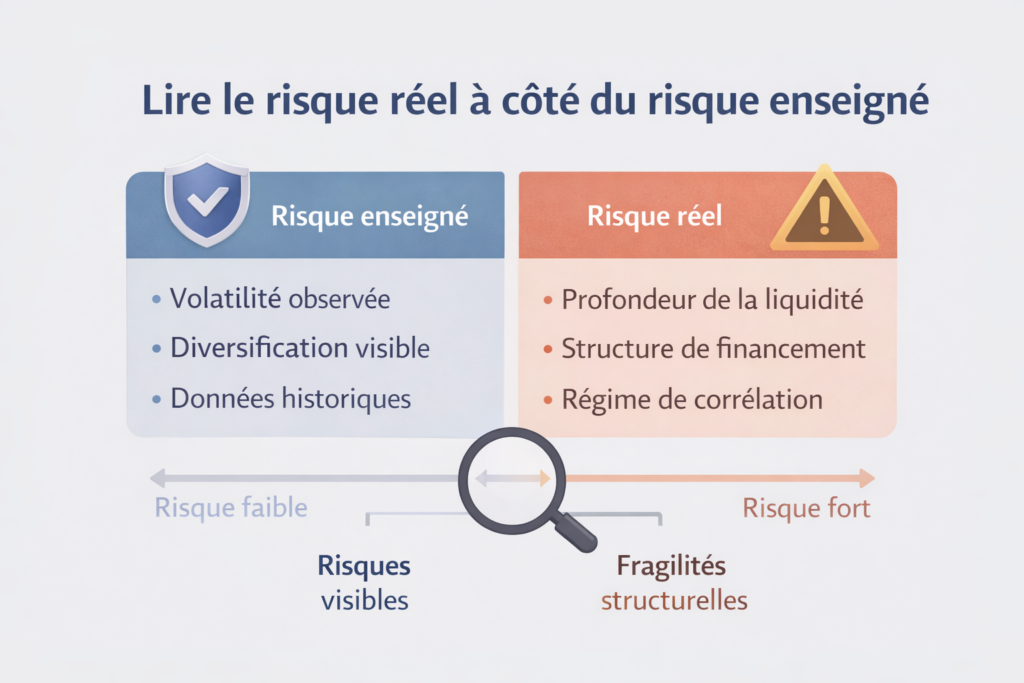
This analytical framework distinguishes surface stability from genuine soundness, and identifies situations where the risk assumed is not properly compensated.
The Limits of This Approach
It provides no timing indication, no alert threshold, no turnkey methodology. It does not replace the fundamental analysis of assets but renews its perspective.
The aim is not to dismiss financial education but to fill its gaps.
Mainstream financial education teaches how to manage observable volatility, but leaves structural risks tied to financing regimes and cycle shifts off the radar.
Conclusion: Reading Risk Where It Hides
Financial education performs an indispensable function but conveys a truncated representation of risk. By privileging what is easily quantified, it tends to overlook what weighs most when regimes turn. Where that perimeter ends, the measured gap between knowledge and behaviour begins: the core of the limited effectiveness of financial education.
Genuine risk is neither stable nor symmetric. It migrates, concentrates, and disappears from pedagogical screens before resurfacing. Capturing it requires moving past surface indicators to scrutinize the underlying architectures.
It is in reading these internal dynamics, far more than in tracking indices or averages, that the genuine added value of a mature financial approach resides.
Last updated — 22 September 2026
Disclaimer – Financial and Legal Information: The analyses, commentary, and content published on eco3min.fr are provided for informational and educational purposes only. They do not constitute investment advice or a solicitation to buy or sell financial instruments. Past performance is not indicative of future results. All investment decisions involve risk and are the sole responsibility of the reader. Data, charts and calculated series are provided as is and may contain errors or lag behind their source: check any figure against the primary source cited before relying on it. Content describing laws, regulations or contracts reflects the law as of its publication date and does not constitute legal or tax advice; applying it to a specific situation requires a qualified legal or tax professional.
Read next
Full pillar →How Much Cash American Households Hold: Deposits, Money Funds, and the Savings Mix
The Federal Reserve’s accounts show American households holding nearly 14.9 trillion dollars in deposits and currency and 5.3…
A high-yield savings account and a money market fund cannot be compared on their headline yield alone. The…
Series I and EE Savings Bonds: Locked Formulas in a Moving Rate World
US savings bonds lock a rate formula at the moment you buy them, for the life of the…