
US Data Release and Rate Reset Dates: Reference Index
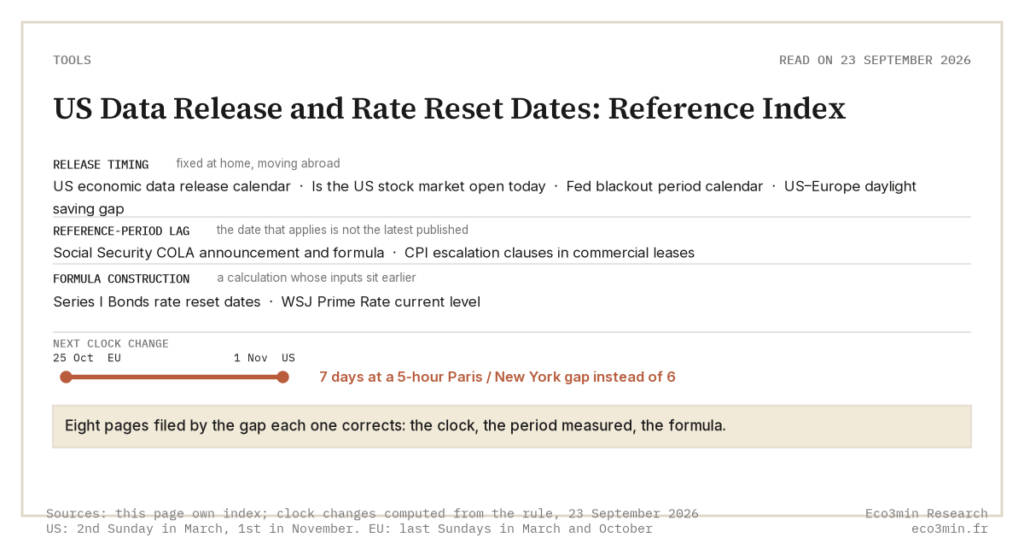
A payroll print, a savings bond reset, a lease escalation and a central bank decision all land on a known date. What they rarely land on is the date that matters: the release date is not the reference period, and the reference period is not the date the number takes effect. This index collects the Eco3min reference pages built around those recurring events, grouped not by topic but by the kind of gap that produces the mistake — release timing, reference-period lag, and formula construction. Each page answers the date or level question first, then explains the rule that generates it.
The pages, grouped by type of gap
Release timing
The number lands at a fixed moment. Which moment depends on the agency, the calendar and, for anyone reading from outside the United States, the time of year.
US economic data release calendar — most federal statistical releases share a single embargo time in Eastern Time, but some widely followed indicators do not, and arrive later in the American morning and afternoon. The page also covers the second gap: the distance between the publication date and the month or quarter the figure actually measures.
Is the US stock market open today — session hours, exchange holiday closures — which do not line up exactly with the federal holiday calendar — early closes, and a bond market calendar that differs from the equity one.
Fed blackout period calendar — the window in which Federal Reserve officials stop commenting on monetary policy is not read off the meeting calendar directly. It opens on the second Saturday before the meeting and closes the day after the meeting ends. Scheduled public remarks therefore fall outside that window.
US–Europe daylight saving gap — the United States shifts on the second Sunday in March and the first Sunday in November; the European Union shifts on the last Sunday in March and the last Sunday in October. For a few weeks each year the usual offset between the two zones does not hold, which matters for anyone scheduling around a US release from Europe or trading a European session against a US one.
Reference-period lag
The figure exists, but the one that applies is not the one most recently published.
Social Security COLA announcement and formula — the adjustment is announced in the autumn and applies to benefits payable from the following January. It is computed from the CPI-W, not the headline CPI-U, and it compares the third quarter of the current year with the third quarter of the last year in which an adjustment was actually determined, which is not mechanically the year before.
CPI escalation clauses in commercial leases — the Bureau of Labor Statistics publishes several CPI series, and the one a contract names changes the result. The publication lag then decides which reference month is available on the adjustment date written into the lease.
Formula construction
The published level is the output of a calculation whose inputs sit elsewhere, and sometimes of a step that is not a calculation at all.
Series I Bonds rate reset dates — Treasury sets new rates each May 1 and November 1, but the composite rate is not the sum of its two parts, and the six-month period that governs an individual bond runs from its issue month rather than from the reset date. Two bondholders can hold the same instrument and be earning different rates on the same day.
WSJ Prime Rate current level — the prime rate quoted across US consumer lending is not published by a regulator. It comes from a survey of large US banks rather than from a regulator, and its changes have followed Federal Reserve decisions rather than a publication calendar of its own.
Why the gap is the norm rather than the exception
The three groups above have different causes and the same consequence: the figure or the hour being read is not the one that applies.
Release timing is a question of institutional practice and statute. Embargo hours are set by the issuing agency; market sessions are set by the exchange; clock changes are set by national law, and the United States and the European Union legislate theirs separately. Nothing obliges those calendars to agree, and for several weeks a year they do not.
Reference-period lag is a question of measurement. A statistical agency observes a period, processes it, and then publishes: the release necessarily follows the period it describes. Once a contract or a benefit is indexed to that series, a second question arrives on top of the first — not what the latest figure is, but which figure was available, or specified, on the adjustment date that governs.
Formula construction is a question of design. An indexed rate applies to a forward period a calculation fed by backward data. Several of these mechanisms then add a discretionary step, or a rounding and combination rule that is not intuitive. Reading the formula output as the applicable level is a common error, and a categorical one rather than a rounding one.
What these pages correct
Three mistakes recur, one per group. Converting a US release time once and treating it as settled for the year. Reading a statistic as a description of the month it appears in. Applying the most recently published index instead of the one the contract designates. None of the three is fixed by looking up a number; each is fixed by understanding the rule that produces the number, which is what each page above sets out to do.
These mechanisms sit inside a wider frame, covered in the sections on macro-financial regimes and research and data. Ongoing coverage of the same releases runs through Macro Watch.
Frequently asked questions
Why do US and European clocks fall out of step for a few weeks each year?
Because two independent calendars govern them. US daylight saving time runs from the second Sunday in March to the first Sunday in November under federal statute, while the European Union switches on the last Sunday in March and the last Sunday in October under its own directive. Between the American change and the European one in spring, and between the European change and the American one in autumn, the usual offset between the two zones narrows by an hour.
Does a release published today describe today?
No. A statistical release covers a period that has already closed — a month, a quarter, sometimes an average across several months. The interval between the end of that period and the publication date is collection and processing time. The same figure can therefore be recent by its release date and old by its reference period. In France, INSEE runs the same two clocks, which is the organising idea of the France release calendar and its reference periods.
Why is the Social Security COLA not simply last year’s inflation?
Two reasons. It uses the CPI-W, an index built on the spending patterns of urban wage earners and clerical workers, rather than the broader CPI-U quoted in headlines. And the comparison is anchored to the third quarter of the last year in which an adjustment was determined, which is normally but not always the previous year: in a year with no adjustment, the benchmark quarter stays where it was.
Which CPI series applies to a lease escalation clause?
The one the contract names. The Bureau of Labor Statistics publishes several CPI series that differ by population covered, geography and seasonal adjustment, and they do not move identically. A clause that refers to the CPI without further specification leaves the question open, which is why the Bureau publishes guidance addressed to contract drafters.
Is the WSJ Prime Rate set by the Federal Reserve?
No. It is a published survey of the rates large US banks charge their most creditworthy customers, not a policy rate and not a regulatory ceiling. Its changes have followed Federal Reserve decisions in practice, but the survey and the policy decision remain separate acts, and the survey’s own definition is set by the publisher rather than by a regulator.
Why do the French and English pages in this index cover different subjects?
Because some of these mechanisms exist on one side only. There is no American Livret A and no French equivalent of the annual benefit adjustment. Where that is the case, the English page covers a US instrument built on the same mechanism rather than translating the French one. Subjects that genuinely concern both markets are covered on both sides.
Last updated — 8 October 2026
Disclaimer – Financial and Legal Information: The analyses, commentary, and content published on eco3min.fr are provided for informational and educational purposes only. They do not constitute investment advice or a solicitation to buy or sell financial instruments. Past performance is not indicative of future results. All investment decisions involve risk and are the sole responsibility of the reader. Data, charts and calculated series are provided as is and may contain errors or lag behind their source: check any figure against the primary source cited before relying on it. Content describing laws, regulations or contracts reflects the law as of its publication date and does not constitute legal or tax advice; applying it to a specific situation requires a qualified legal or tax professional.
Regulated and tax values: the rates, indices, caps and brackets with legal effect cited on this page are set by official decision, change over time and apply according to individual circumstances. Only the official publication in force on the relevant date is authoritative (for example the Journal officiel, INSEE, Banque de France, the IRS or the Social Security Administration). To revise a rent, sign or challenge a contract, or file a return, check the value at the source or with a professional.