
Saving vs Investing vs Placing: Understanding Risk, Time, and Liquidity

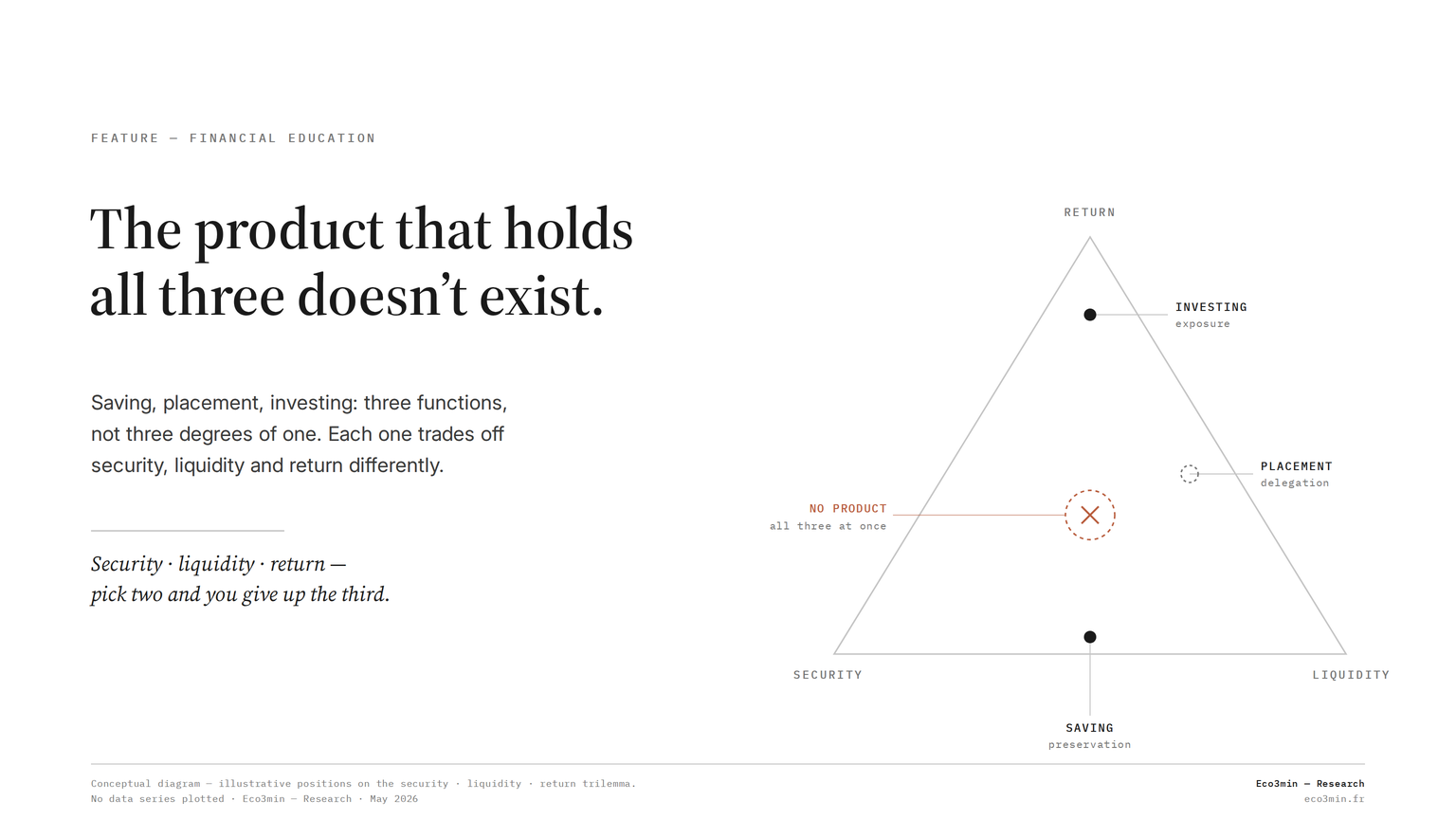
Saving, placing, and investing refer to three distinct financial functions. Understanding their differences in risk, time horizon, and liquidity.
TL;DR
Saving, placing, and investing answer three different financial functions with distinct risk, time, and liquidity profiles, and no single product combines liquidity, nominal safety, and high returns.
- The AMF's 2025 Savings and Investment Barometer found 61% of French adults say they know savings and investment products poorly, and only 13% answered all three of its financial-literacy questions correctly.
- Quarterly national accounts (Eurostat) put the French household saving rate at 17.2% of gross disposable income in Q3 2025 and 17.4% in Q1 2026, much of it concentrated in capital-guaranteed products.
- Eurostat data show euro-area households holding 31.3% of financial assets in deposits and cash at end-2025, EUR 11,011bn out of EUR 35,132bn, a share broadly stable for a decade despite years of negative real rates.
Saving, placing, investing: three verbs often used interchangeably in everyday language, yet they reflect fundamentally different financial logics. Each implies a distinct relationship to risk, time, and liquidity: three dimensions that most individuals never explicitly separate. Eco3min quantifies the liquidity dimension, the penalty for tapping funds ahead of term, in the cost of early access to capital. This confusion is not trivial: it leads to evaluating financial products without understanding the function they are meant to serve. A savings account is not designed to generate returns, just as an equity investment is not meant to preserve capital in the short term. Establishing these distinctions provides a framework before even considering specific financial products. For more detail: Past Performance: Why It Provides False Reassurance.
What most financial product analyses overlook is this: the confusion between these three functions does not only create individual disappointment, it distorts aggregate savings behavior. The evidence is brought together in this analysis of strategic financial buyers m&a premium. That distortion compounds with the price-level dynamics covered in the complete guide to inflation. When millions of households treat a savings account like an investment, or equities as a short-term reserve, capital flows are misallocated toward uses they were not designed for. This structural mismatch carries a collective cost that is rarely measured.
Three functions, three distinct logics
Saving, in its strict sense, fulfills a preservation function. Its objective is to maintain capital that is available, liquid, and nominally stable. Instruments such as regulated savings accounts or short-term time deposits are the most direct expressions: capital is guaranteed in nominal terms, and access is immediate or near-immediate. The AMF Savings and Investment Barometer (2025 edition, surveyed between 19 September and 3 October 2025 among 2,120 people) measures the gap differently: 61% of French adults say they know savings and investment products poorly, against 59% in 2024, and only 13% answered all three of its financial-literacy questions correctly. Vocabulary is not the cause of that gap, it is its most visible carrier. Related study: The Livret A Is Neither Good Nor Bad: It Is a Function.
Placing introduces delegation. The term suggests entrusting money to a vehicle or manager, with an implicit expectation of returns higher than pure savings. Why pure savings rarely keep pace with prices is documented in the true cost of leaving savings exposed to inflation. But this expectation obscures a key reality: any placement carries risk (interest rate risk, market risk, or inflation risk) that the term itself tends to downplay. Understanding what the word “placement” conceals means identifying the gap between perception and the product’s actual function.
Investing, finally, is a deliberate exposure to uncertainty. The investor accepts the possibility of loss in exchange for expected returns. It is the boundary between preservation and exposure that defines the fundamental distinction: saving is about rejecting risk; investing is about accepting it under specific conditions. Drawn that sharply, the distinction still leaves open why households accumulate so little on the preservation side: a shortfall that sits at the heart of the puzzle of household saving below model predictions.
Risk, time, liquidity: a structural trilemma
Each financial function is defined by a combination of three variables. Saving prioritizes liquidity and nominal safety, at the cost of low or even negative real returns. Investing accepts temporary illiquidity and the risk of loss in exchange for potentially higher long-term returns. Placing occupies an intermediate zone, often poorly defined, where expectations of return coexist with a tolerance for risk that is rarely made explicit. Adjacent reading: our study of the pre-tax 401(k) deduction.
The most common trap is trying to achieve all three simultaneously: a product that is liquid, risk-free, and high-performing. This trilemma does not exist. According to quarterly national accounts (Eurostat, seasonally and calendar adjusted), the French household saving rate stood at 17.2% of gross disposable income in Q3 2025, behind Ireland (19.6%), Germany (19.5%) and the Netherlands (17.4%), but well ahead of Italy (11.5%) and Spain (12.0%). It was still 17.4% in Q1 2026. Yet a significant share of this savings remains concentrated in capital-guaranteed products, raising a structural question: does this allocation reflect informed choice, or confusion between functions? How the main vehicles arbitrate among those three promises is compared in active funds, index ETFs and direct securities as routes to the market.
The dominant narrative often interprets this concentration as excessive prudence among French households. The reality is more nuanced: it also reflects the absence of a clear framework to distinguish precautionary savings, intermediate placement, and deliberate risk exposure. The issue is not prudence: it is the lack of functional segmentation. Some of this savings could serve an investment function if the distinction were made upfront, but this cannot be assumed without considering each individual situation. Related reading: Barbell Strategy: Rethinking Risk Allocation in a High-Rate Environment.
Believing that a product can be liquid, high-performing, and risk-free at the same time. This expectation stems from confusion between financial functions. In practice, every financial product involves trade-offs: it never combines all three. Evaluating a savings account based on its return or an equity portfolio based on its safety means applying the wrong criteria to the wrong function.
Where the mismatch shows: France’s regulated savings stock
Some products blur the categories by design. A euro-denominated life insurance fund is perceived as savings, yet it carries interest rate and liquidity risk. The fuzziness is not new either: in the AMF barometer, the share of French adults who say they know savings and investment products poorly has not fallen below 52% since 2017.
The cost shows up as a mismatch between how long capital stays put and the nature of the vehicle that holds it. According to the Banque de France annual report on regulated savings, the Livret A (€440 billion), the LDDS (over €160 billion) and the LEP (€84 billion) held about €685 billion together at end-2025. Regulated savings as a whole, home-savings plans included, came to €948 billion, a stock of which a significant portion far exceeds any precautionary reserve need.
Rates added to the blur. After a decade of near-zero rates, the rise in ECB policy rates temporarily lifted the nominal yield of passbooks. The visible remuneration of savings then reinforced the idea that they could also “perform”, further blurring the boundary with investment.
Time: the most underestimated variable
The most overlooked dimension in this confusion is time. A two-year horizon does not allow for the same vehicles as a twenty-year horizon. The difference is not merely quantitative: it fundamentally changes the nature of acceptable risk. It is the structuring role of time horizon that explains why the same product can be either appropriate or unsuitable depending on the duration considered. Further reading: the mechanics and limits of dollar-cost averaging.
According to the OECD long-run scenarios published in September 2025, potential GDP per capita growth across the OECD area averages 1.5% a year out to 2050, while global potential output growth eases from about 2.9% today to 2.7% in the early 2030s. Reference release: the OECD global long-run economic scenarios. In this context, the distinction between saving and investing becomes even more critical: capital without a clearly defined function will not benefit from the same compounding effects. And it is precisely the multiplier effect of time that explains why delaying an investment decision has an exponential, not linear, cost.
What this confusion changes in practice
The most widespread illusion concerns returns. Many individuals look for a “good investment” by focusing solely on past performance, without distinguishing the function the product is meant to serve. They project investment expectations onto savings products, or vice versa. This mismatch fuels the illusion of guaranteed returns: a concept that financial theory itself treats as a fragile convention, not a market reality. Related analysis: how a 1% fee erodes capital over twenty years.
According to Eurostat financial accounts, euro area households held EUR 11,011bn in deposits and cash at end-2025 out of EUR 35,132bn in total financial assets, or 31.3%, against 32.1% at end-2015. The share erodes slowly, it does not shift, despite several years of negative real interest rates. This aggregate behavior suggests that confusion between functions does not self-correct through market conditions alone. Correcting it is a matter of financial education, the ground the financial education pillar on inflation, interest rates and money decisions covers.
If this framework were to be invalidated, it would require the emergence of financial products genuinely capable of combining liquidity, safety, and returns: a scenario that neither current market conditions nor regulatory trends make likely. Conversely, a prolonged environment of low real interest rates would further reinforce the need to clearly distinguish these functions in order to understand what each financial vehicle actually delivers.
Confusing saving and investing does not only create individual risk: it distorts capital allocation at the level of an entire economy.
Saving, placing, investing: three functions, three relationships to risk, time, and liquidity. Establishing this framework does not solve decisions, but it prevents making them based on confusion. Multiple paths remain possible depending on macroeconomic, fiscal, and personal contexts. The distinction proposed here is not a decision-making tool: it is a lens, applicable to every concrete choice encountered in everyday financial trade-offs. On the same theme: the Eco3min study of the suite of assumption-testing tools.
- Saving preserves capital in nominal terms; investing exposes it to risk in exchange for expected returns: two distinct functions, not two degrees of the same action.
- The term “placement” obscures risk exposure by suggesting safety, which distorts product evaluation.
- No financial product combines full liquidity, nominal safety, and high returns: this trilemma structures every financial decision.
- Time horizon determines the nature of acceptable risk, not just its magnitude: it is the primary variable to identify.
Last updated — 20 October 2026
Disclaimer – Financial and Legal Information: The analyses, commentary, and content published on eco3min.fr are provided for informational and educational purposes only. They do not constitute investment advice or a solicitation to buy or sell financial instruments. Past performance is not indicative of future results. All investment decisions involve risk and are the sole responsibility of the reader. Data, charts and calculated series are provided as is and may contain errors or lag behind their source: check any figure against the primary source cited before relying on it. Content describing laws, regulations or contracts reflects the law as of its publication date and does not constitute legal or tax advice; applying it to a specific situation requires a qualified legal or tax professional.
Regulated and tax values: the rates, indices, caps and brackets with legal effect cited on this page are set by official decision, change over time and apply according to individual circumstances. Only the official publication in force on the relevant date is authoritative (for example the Journal officiel, INSEE, Banque de France, the IRS or the Social Security Administration). To revise a rent, sign or challenge a contract, or file a return, check the value at the source or with a professional.
Read next
Full pillar →How Much Cash American Households Hold: Deposits, Money Funds, and the Savings Mix
The Federal Reserve’s accounts show American households holding nearly 14.9 trillion dollars in deposits and currency and 5.3…
A high-yield savings account and a money market fund cannot be compared on their headline yield alone. The…
Series I and EE Savings Bonds: Locked Formulas in a Moving Rate World
US savings bonds lock a rate formula at the moment you buy them, for the life of the…